

How to Condition Leather: Fast, Safe, Expert-Backed Guide
Leather conditioner helps keep the material flexible and slows down drying, stiffness, and surface cracking. The goal is not to saturate the leather with product, but to restore it carefully and without changing the texture more than necessary.
How to condition leather safely
Basic conditioning routine:
- Clean — Remove dust, dirt, and surface grime with a soft brush or damp cloth. If the item is soiled, use a pH-neutral leather cleaner. Let it air-dry completely.
- Spot-test — Apply a very small amount of conditioner to a hidden area and leave it for 12–24 hours. Check whether the leather becomes noticeably darker, tacky, or unstable.
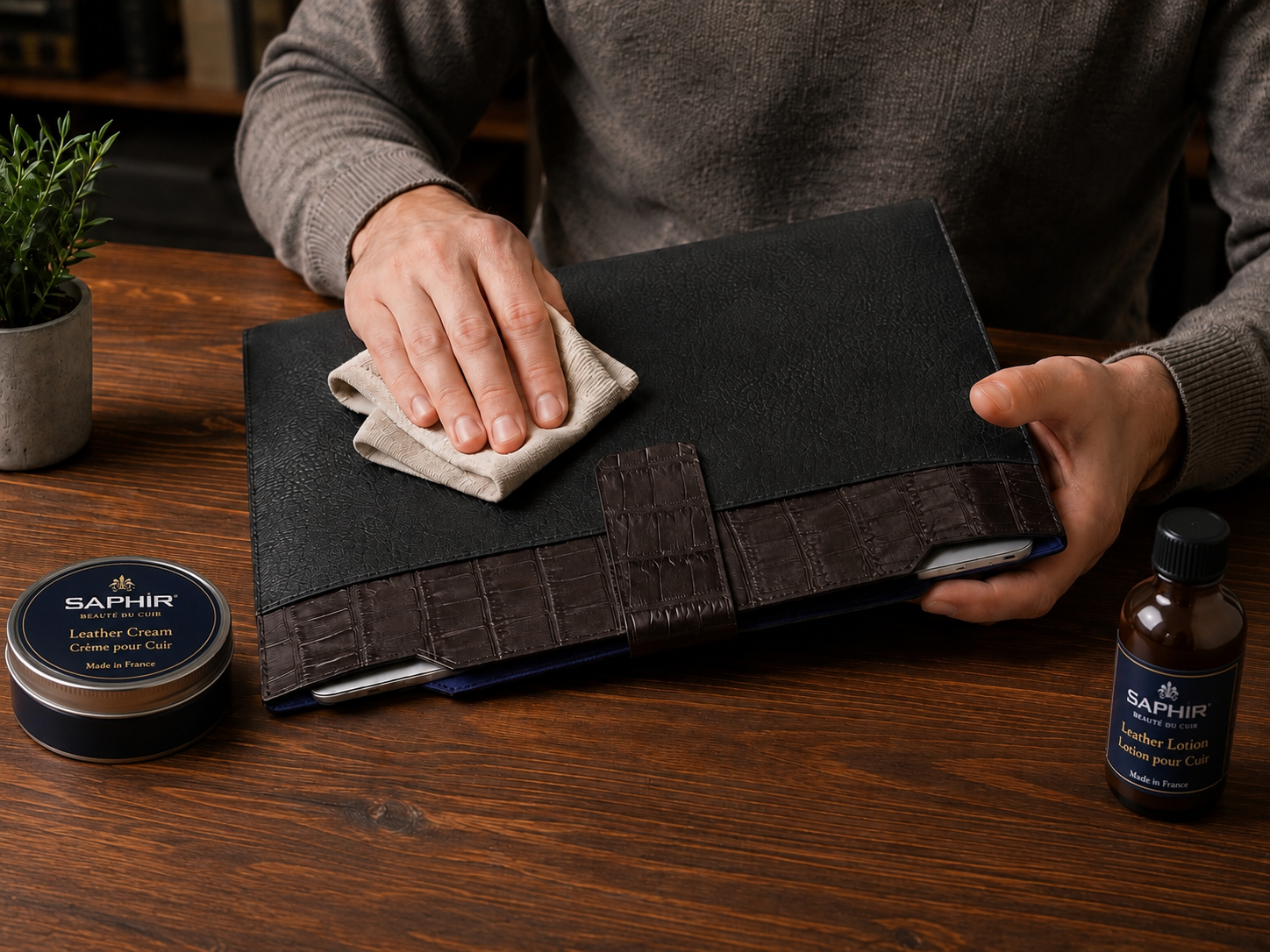
- Apply — Use a lint-free cloth to apply a thin, even coat in small sections with circular motions. Avoid excess buildup on seams and stitching.
- Absorb — Let the conditioner penetrate for 10–30 minutes. If the leather still feels dry after the first coat, apply a second thin layer.
- Buff — Use a clean, soft cloth to remove any excess and create an even sheen. Let the item cure for several hours before wearing or using it.
How often should you condition leather?
It depends on climate and use:
- Dry or hot climates, frequent use, direct sun exposure: every 1–3 months
- Moderate climate, office or occasional use: every 3–6 months
- Humid climate, rare use: every 6–12 months
Signs that leather needs conditioning: dryness to the touch, dull appearance, fine wrinkles forming on the surface, or a faint squeaking sound when flexed.
Never “soak” the leather. Multiple thin coats are always better than one heavy application. If dye rubs off during the spot-test, stop immediately and consider color-safe products or professional restoration.
Leather types: what you can and cannot condition
Not all leather should be treated the same way. The wrong product can leave darkening, residue, or permanent texture changes.
Smooth leather: what usually works
Most smooth leather items can be conditioned, but not every product is equally safe. If you are unsure, start with a light cream or balm rather than oil. Full-grain and top-grain leather usually tolerate conditioning well. Corrected or coated leather absorbs less, so heavy products often stay on the surface instead of helping.
Aniline and semi-aniline leather need extra caution because they darken more easily and show product marks faster. Pull-up leather can also change appearance quickly, so the goal is to use less product, not more. If the item is light-colored, thin, or expensive, test first and avoid heavy oils unless the manufacturer recommends them.
When standard conditioner is the wrong choice
Suede and nubuck should not be treated with standard creams, balms, or oils. These materials have an open fiber surface, and the wrong product can leave dark patches, clump the nap, and permanently change the texture. Use only products made specifically for suede or nubuck.
Patent leather does not need conditioning in the usual sense because the surface is coated. Faux leather and PU do not absorb leather conditioner at all, so standard products usually create residue instead of helping. Exotic leathers are a separate category and should only be treated according to the manufacturer’s care instructions.
Choose the right conditioner
Choosing the right product matters more than buying the “strongest” one. For most smooth leather items, a light cream or balm is the safest place to start. Oils and waxes are more situational and can easily do more harm than good on thin, light, or delicate leather.
Forms and when to use them
Cream or balm is the most versatile option. It restores moisture without heavy darkening or altering the leather’s texture. Creams absorb evenly and maintain color consistency. Use them for wallets, bags, jackets, and everyday shoes.
Oil (neatsfoot, mink, or blended formulas) penetrates deeply and softens the leather. It works well for outdoor boots and work gear but can darken lighter leathers and reduce structural stiffness. Use oils sparingly on thin items like wallets or jackets.
Wax (beeswax-based) adds water resistance and creates a protective barrier. It reduces breathability and can dull the surface if over-applied. Use wax on outdoor shoes or work boots, ideally as a top layer over cream.
Sprays offer fast, even application. They work well on smooth leather but require careful selection—some sprays are formulated for suede or nubuck and will not work on finished leather. Always check the label.
Who should use what:
- Everyday shoes and bags: cream or balm
- Outdoor boots: wax over cream
- Jackets and apparel: cream or balm (avoid wax)
- Wallets and small goods: light cream
- Furniture: neutral balms designed for large surfaces
What to avoid
Avoid household oils and improvised home remedies. Products such as olive or coconut oil can stain the surface, attract dirt, and age poorly over time. Be careful with heavy oil-based formulas on light or thin leather, because they darken faster and are harder to correct if the result goes wrong.
If the label does not clearly say what type of leather the product is for, do not treat it as a universal solution. A safer approach is to choose a product made for the specific leather type and start with the lightest effective option.
Decision table — match leather, conditioner, effects, notes
|
Leather type
|
Safe starting option
|
What to avoid
|
Darkening risk
|
|---|---|---|---|
|
Full-grain / top-grain
|
Light cream or balm
|
Heavy over-application
|
Low to medium
|
|
Aniline / semi-aniline
|
Very light cream, hidden-area test first
|
Heavy oils
|
High
|
|
Corrected / coated leather
|
Light cream in a thin layer
|
Heavy oils and wax buildup
|
Low
|
|
Pull-up leather
|
Small amount of suitable conditioner
|
Over-softening
|
Medium to high
|
|
Suede / nubuck
|
Only suede-specific products
|
Creams, balms, oils
|
N/A
|
|
Patent / faux / PU
|
Surface-specific care product
|
Standard leather conditioner
|
N/A
|
Detailed application: preparation, testing, application, curing, buffing
Even a good product can give a bad result if it is applied carelessly. Most problems come from three things: dirty leather, too much product, or skipping the hidden-area test.
Clean first, test second
Before applying any conditioner, remove dust and surface dirt with a soft cloth or brush. If the item is visibly dirty, use a leather cleaner and let the surface dry completely. Conditioner should never be applied over grime or onto damp leather.
Once the item is clean, test the product on a hidden area. Wait long enough to see whether the leather darkens too much, becomes tacky, or starts releasing color. If any of these happen, stop and switch to a gentler product or ask a professional before treating the whole item.
Apply in thin layers
Apply conditioner in a thin, even layer using a soft lint-free cloth. Work in small sections and avoid letting product collect around seams, stitching, or decorative details. One light coat is usually safer than one heavy application.
Let the leather absorb the product for a short time, then check the surface before adding more. If it still feels dry, apply another thin layer rather than trying to fix everything at once. Finish by buffing off any excess with a clean cloth and let the item rest before use. Do not use heat to speed up drying.
Maintenance schedule, environment, and protection
Leather does not need conditioning on a fixed schedule. What matters more is use, dryness, heat, sun exposure, and visible changes in the material.
How often leather needs conditioning
Leather does not need conditioning on a rigid schedule. What matters is use, dryness, heat, sun exposure, and visible changes in the surface. Daily-use footwear usually needs care more often than bags, wallets, or jackets used occasionally.
A practical rule is simple: do not condition by calendar alone. Condition when the leather starts to look dull, feels dry, develops fine surface creasing, or loses flexibility. In many cases that means every few months for regularly used items, such as a wallet, bag, or iPhone 17 leather case, and less often for things kept in stable indoor conditions.
Protection layering and storage
Conditioning and waterproofing are not the same step. If extra protection is needed, condition the leather first, let it rest, and only then apply wax, waterproofing, or polish. Doing it in the opposite order reduces absorption and often creates buildup. Store leather in a dry, ventilated place away from direct sunlight, heat, and sealed plastic bags.
Store leather in a dry, ventilated place away from direct sunlight, radiators, and sealed plastic bags. Footwear benefits from shoe trees, and jackets keep their shape better on proper hangers. Good storage will not replace conditioning, but it helps leather age more evenly.
Mistakes and troubleshooting
Most conditioning mistakes are fixable, but some require professional help.
Mistakes that damage leather faster
The most common mistake is using too much product. Excess conditioner does not make leather healthier — it leaves residue, attracts dirt, and can make the surface feel greasy or sticky. Another common error is using the wrong product on the wrong material, especially on suede, nubuck, or light-colored leather.
Heat is also a frequent cause of damage. Trying to speed up drying with a hairdryer or heater can leave dark marks and harden the surface unevenly. If you are unsure about the leather type or the conditioner, the safer option is to test first or stop before treating the whole item.
What to do if something goes wrong
If the surface becomes sticky, greasy, or develops an artificial shine, there is probably too much product on it. Remove the excess carefully, let the item rest, and do not add more conditioner until the leather stabilizes. If dark patches or uneven color appear, stop experimenting — repeated layering often makes the result worse, not better.
When the leather starts releasing dye, shows deep cracking, separates in layers, or stays stiff after careful treatment, home care is no longer enough. At that point, professional restoration is the safer option.
FAQ
What if I am not sure what type of leather I have?
Start with a hidden-area test and only use a mild product if you are reasonably sure the item is smooth leather.
When is home conditioning a bad idea?
Home care is not the best option when the leather has deep cracks, visible color loss, mold, persistent stiffness, or previous product buildup. It is also worth being more careful with light-colored, delicate, or high-value items where a failed treatment would be difficult to reverse.
Can conditioner fix badly dried or damaged leather?
It can improve dryness and surface stiffness, but it cannot repair structural damage. If the leather is already splitting, peeling, or losing finish, conditioner will not solve the underlying problem.