

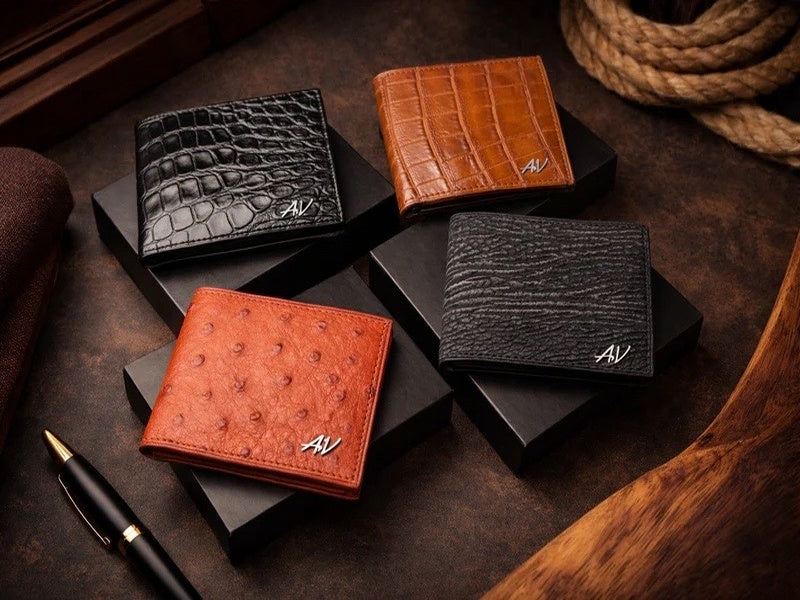
How to choose a leather wallet: the ultimate buyer's guide
A good leather wallet should match how you actually carry it, not just look good in photos. Start with three things: how many cards and how much cash you carry, where you keep the wallet, and whether you care more about slimness, capacity, or long-term durability. Once that is clear, it becomes much easier to choose the right style, leather type, and build quality.
Quick decision checklist: how to avoid common mistakes
Before diving into the details, start with this checklist to clarify what you actually need:
- where will you carry it? Front pocket, back pocket, jacket, or bag? That determines how much bulk you can comfortably carry. A thick wallet in your back pocket can also become a real comfort problem over time, especially if you spend long periods sitting.
- what will you carry? Mostly cards, or cash too? Check the number of card slots and the depth of the bill compartment. If you rarely use cash, a cardholder or slim bifold usually makes more sense than a bulky trifold.
- which wallet style fits your routine? Bifold for balanced capacity, cardholder for minimal carry, trifold for maximum storage, travel wallet for documents and multiple currencies.
- what leather quality can you verify? Full-grain and top-grain are the strongest bets; “genuine leather” is a broad label that doesn’t guarantee quality. Look for clear material descriptions, not vague marketing language.
- what should you inspect before buying? Even stitching with no gaps, smooth or burnished edges—not thick paint that can crack—secure hardware, and realistic card-capacity claims.
Before you start: define your needs and carry style
Step 1: determine size and carry method
How you carry your wallet determines how much size and thickness you can comfortably live with.
If you carry your wallet in a front pocket, keep it slim. A thick wallet adds bulk, feels worse when sitting, and is harder to carry comfortably every day. A slim bifold or cardholder is usually the best fit.
A back pocket gives you more room, but thickness still matters. If you sit for long periods, even a fairly flat wallet can become annoying over time. If comfort matters, avoid overstuffed designs.
Jacket or bag carry makes larger formats practical. You’re not limited by pocket dimensions, so trifolds, long wallets, and travel organizers become realistic options. They can hold more cards, cash, and even documents, though they’re less convenient if you need quick access without opening a bag.
Before you choose a wallet, look at your current habits:
- Which pocket do you use most?
- How many times a day do you pull it out?
- Do your pants have shallow or deep pockets?
- How thick can it get before it becomes uncomfortable when you sit?
A slim wallet works best if you carry only the essentials. If you carry cards, cash, and receipts, a cardholder usually becomes annoying fast.
Choose size first. It eliminates the wrong wallet types before you start comparing leather and features.
How many cards and how much cash do you carry?
Start by counting your daily essentials:
- Cards: credit and debit cards, ID, transit passes, insurance cards
- Cash: do you carry bills every day, or just occasionally?
- Extras: receipts, coins, keys, or small backup items
This is the fastest way to narrow your options. If you only carry a few cards, do not buy a bulky wallet built for receipts, coins, and travel documents.
Carry Profile Recommendations
|
Carry Profile |
Cards |
Cash |
Coins |
Recommended Type |
|
Minimalist |
1-3 |
Rarely |
No |
Cardholder, MagSafe wallet, slim card holder |
|
Balanced |
4-6 |
Occasionally |
Optional |
Slim bifold, standard bifold |
|
Cash-heavy |
4+ |
Frequently |
Yes |
Trifold, long wallet with coin pocket |
|
Traveler |
6+ |
Multiple currencies |
Yes |
Travel organizer with passport slot, RFID blocking |
If you’re mostly cashless, a cardholder with a single bill slot is usually enough for emergencies without adding unnecessary thickness. If you regularly carry multiple currencies or like to keep receipts organized, dedicated compartments can save time and help keep things in order.
Choose a wallet style that matches your needs
Step 2: choose the right wallet style (bifold, billfold, trifold)
For most people, the choice is simple:
- Bifold is the safest default: enough room for daily cards and some cash without getting too bulky.
- Trifold makes sense only if you carry more cards, receipts, or coins and do not mind extra thickness.
- Cardholder is best if you mostly pay by card and want the slimmest option.
- If a wallet needs to carry passport-sized items or multiple currencies, that is no longer an everyday wallet — it is a travel wallet.
Minimalist and cardholder: when you need an ultra-thin format
Choose a cardholder if you carry only a few cards and rarely use cash. Choose a slim bifold if you still want a bill compartment without moving up to a thicker wallet.
Many people who prefer minimalist carry also choose an iPhone 17 leather case for the same reason: it keeps everyday essentials slim while still adding protection and premium feel. Full-grain leather cases are especially popular because they develop a more natural patina from daily handling instead of looking worn out too quickly. A soft inner lining and reinforced corners are also worth checking if you want better long-term protection for the device.
Leather type is the key decision for durability and appearance
Step 3: evaluate material and leather quality
Leather grade matters more than most extra features because it affects durability, aging, and overall feel.
Full-grain is the best choice if you care about long-term durability and natural aging.
Top-grain is a good middle ground if you want a smoother, more uniform look.
Corrected-grain is more processed and usually less characterful over time.
Bonded leather is the one to avoid if you want durability.
Also, treat “genuine leather” as a vague label, not proof of quality.
When evaluating leather in person:
- Touch it: full-grain usually feels firm but flexible, with a slightly uneven natural texture. Top-grain feels smoother and more uniform. Corrected leather can feel more plasticky.
- Look at the edges: high-quality leather should have clean, burnished edges. Thick paint or rough exposed fibers usually point to lower quality.
- Check the color: natural leather typically shows slight variation. If the color is perfectly uniform, it has probably been more heavily finished or corrected.
For maximum durability, choose full-grain. For a balance of price and appearance, top-grain is often the sweet spot. And if transparency matters to you, buy from brands that clearly state the leather grade and tanning method.
|
Leather Type |
Durability |
Patina |
Scratch Resistance |
Price |
Care |
|
Full-grain |
usually the best long-term option |
High |
High |
$$$ |
Condition occasionally, depending on use and the maker’s care instructions. |
|
Top-grain |
durable for everyday use |
Low |
Medium |
$$ |
Wipe with a damp cloth |
|
Corrected-grain |
acceptable, but usually ages less well |
Low |
Medium |
$$ |
Surface wipe only |
|
Bonded |
lower durability and higher risk of peeling or cracking |
None |
Low |
$ |
Surface wipe; avoid oils |
Sources: Hulala Home, 2023; Popov Leather, 2024; Saddleback Leather, 2024; Buffalo Jackson, 2024.
Tanning process: vegetable vs. chrome
Tanning affects how the leather feels, looks, and ages. Vegetable-tanned leather is usually firmer and develops more visible patina over time, while chrome-tanned leather is usually softer and more uniform.
|
Property |
Vegetable-Tanned |
Chrome-Tanned |
|
Stiffness |
Stiff at first, softens with use |
Soft and pliable from the start |
|
Water Resistance |
Low; sensitive to moisture |
Moderate; more water-resistant |
|
Color |
Earthy, muted tones that deepen over time |
Bright, uniform, colorfast |
|
Smell |
Natural leather smell |
Can have a chemical odor |
|
Aging |
Develops rich patina |
Minimal patina |
|
Environmental Impact |
Biodegradable, plant-based tannins |
Requires wastewater treatment and chemical controls |
Vegetable-tanned leather makes sense if you want visible aging and a more natural feel. Chrome-tanned leather is better if you want immediate softness and more stable color.
Check the build quality
Stitching and thread
Stitching quality matters because it often determines how well the wallet holds up over time.
Look for:
- Even stitch spacing: consistent spacing usually signals cleaner workmanship.
- No skipped stitches: gaps in the stitch line create weak points.
- Backstitching at the ends: reinforced start and end points help prevent thread pullout.
- Thick, waxed thread: thin thread wears out faster; wax helps protect against moisture and abrasion.
Higher-quality wallets usually use thicker nylon or polyester thread, often with a wax coating. Cheaper wallets often use thinner cotton thread that frays and snaps more easily.
Edge finishing (burnishing vs. Painting)
The edges of a leather wallet—where the layers meet—tell you a lot about the quality of construction.
Burnished edges are sanded smooth, then polished with wax or gum tragacanth until the fibers compress into a sealed edge. They usually age well and hold up without chipping.
Painted edges are coated with acrylic or resin. They can look clean and uniform at first, but they may crack or peel with repeated flexing, especially on lower-quality wallets that use thick paint to hide rough prep work. Painted edges are not automatically bad, though. When they are done properly, with several thin coats over well-prepared leather, they can hold up well.
Burnished edges generally take more time and skill and tend to age better. Painted edges are faster to produce and can still work well when executed properly, though they may need touch-ups over time.
When checking the edges:
- Run your finger along them: burnished edges should feel smooth and slightly rounded. Well-done painted edges should also feel smooth, though often with sharper corners.
- Flex the wallet: burnished edges should stay intact. Poorly applied edge paint may show small cracks.
- Check the thickness: a thick layer of paint often means it is covering poor prep work underneath.
Functional elements and security: rfid, id window, coin pocket
Modern wallets often come with extra features, but not all of them are worth the added bulk.
RFID blocking is optional, not essential. It makes the most sense if you use contactless cards often and want the extra peace of mind. Otherwise, it is usually a nice-to-have rather than a reason to choose one wallet over another.
ID window: convenient if you show your ID often. The downside is that the clear plastic scratches easily, can leave impressions on the ID itself, and often yellows over time. If you rarely need to show your ID, a standard slot is cleaner and usually more durable.
Coin pocket: useful if you actually carry coins, but it adds bulk—usually because of a zipper or snap closure. If you rarely carry coins, skip it. If you travel internationally and use coins often, it is much more useful.
Quick-access slots: external card slots or pull-tabs let you grab frequently used cards without opening the wallet. They are handy for transit cards or building-access badges, but cards stored externally are more exposed to bending and dirt. If you do not need instant access, internal slots are usually safer.
When you’re evaluating features, ask:
- Does this solve a problem I actually have?
- How much thickness does it add?
- Will I use it often enough to justify the extra bulk?
Capacity and internal organization
Card slots and access
Most people do not need a high-capacity wallet. If you carry 4 to 8 cards, a standard bifold is usually enough. Once you move past that, you are often paying for extra bulk more than extra convenience.
Stacked slots vs. staggered slots: stacked slots, where cards sit directly on top of one another, are thinner but harder to use because you may have to pull out several cards to reach the one underneath. Staggered slots offset the cards so you can see and grab each one more easily, though they add a little more thickness.
If you carry 4-6 cards, staggered slots are usually worth it for the convenience. If you carry 8 or more, stacked slots can help save space.
Bill compartments (single or dual)
A single bill compartment works well for one currency and the occasional receipt. It is the simplest setup and works for most people.
Dual compartments let you separate currencies, denominations, or receipts from cash. They are useful for travelers or anyone who regularly handles different types of payments. The trade-off is more bulk.
Pay attention to compartment depth. If it is too shallow, bills stick out and catch on your pocket. Too deep, and bills bunch up at the bottom and are harder to grab.
If you travel internationally, note that currency size matters. U.S. bills are uniform, but euro notes vary by denomination. Make sure the wallet can hold larger notes comfortably without forcing you to fold them multiple times.
Style and aesthetics
Color, finish, and patina
Leather color has a big effect on how patina shows up over time.
Dark colors usually keep a more consistent look over time. Lighter colors show wear, darkening, and patina more clearly. If you want visible aging, go lighter. If you want a cleaner long-term look, go darker.
Finish types:
- Matte: little to no shine, with a more natural leather look. Scratches and marks show more easily, but the patina tends to look more organic.
- Glossy: polished or waxed surface. Scratches are less obvious at first, but the finish can dull over time.
- Embossed/textured: adds visual interest with an artificial grain pattern, but will not develop a natural-looking patina.
If you want a wallet that looks better over time, go with light-colored full-grain leather in a matte finish. If you would rather keep the look more uniform, a darker top-grain wallet with a light polish is the safer choice.
A quality leather wallet should not only look good when new but also maintain its shape and texture after years of daily use. Full-grain leather usually performs best in this regard because it handles friction and bending more naturally than heavily corrected materials. Details like burnished edges, strong stitching, and properly structured card slots often make a bigger difference in long-term durability than branding or decorative elements.
Hardware and logos
Minimal hardware means fewer snaps, zippers, and metal accents. That makes the wallet lighter and gives it fewer things that can fail over time.
Heavy hardware adds weight and visual presence, but metal parts can tarnish or wear against pocket linings.
Logo placement: subtle logos—like a small debossed mark inside—keep the wallet versatile. Large logos make it feel more branded and can clash with understated or dressier styles.
Common mistakes and how to avoid them
Mistake 1: choosing a thick wallet for front-pocket carry
If you carry a wallet in your front pocket, thickness matters more than extra storage. A bulky wallet is harder to carry comfortably every day, so a slim bifold or cardholder is usually the better choice.
Mistake 2: ignoring leather type and buying “genuine leather”
“Genuine leather” does not tell you the grade. It could mean anything from solid full-grain leather to much lower-grade material. Solution: ask for the specific grade—full-grain, top-grain, or corrected-grain. If the seller cannot tell you, move on.
Mistake 3: adding unnecessary features that increase bulk
RFID blocking, coin pockets, and ID windows all add thickness. If you do not use contactless cards, rarely carry coins, and almost never show your ID, those features are just extra bulk you do not need. Solution: make a quick list of what you actually use day to day and pay only for features you will use regularly.
Mistake 4: ignoring stitching and edge quality
Machine stitching with thin thread and poor edge finishing can look fine at first, but it often fails under everyday stress. Solution: inspect the stitch spacing and edge finish before you buy. Hand saddle stitching and burnished edges—or well-executed painted edges—are worth paying more for if you want a wallet that lasts.
Mistake 5: expecting corrected-grain leather to develop real patina
Corrected-grain leather has sealed pores and artificial grain patterns. It will not develop the rich, natural patina you get with full-grain leather. Solution: if patina matters to you, choose full-grain or vegetable-tanned leather. If you want a more uniform look, corrected-grain can still be a practical option.
Mistake 6: over-conditioning leather
Applying conditioner too often can make leather too soft and darken it unevenly. Solution: condition full-grain leather every few months, not every few weeks, and follow the maker’s care instructions whenever possible.
Quick comparison table: key parameters
|
Type |
Average Thickness |
Card Capacity |
Cash Capacity |
Typical Leather |
Best Use Case |
|
Bifold |
0.5-0.7 inches |
4-8 |
Single compartment |
Full-grain, top-grain |
Balanced everyday use |
|
Trifold |
0.8-1.2 inches |
6-12 |
Dual compartments |
Full-grain, top-grain |
Back pocket, higher-capacity carry |
|
Cardholder |
0.2-0.4 inches |
2-6 |
Minimal (folded bills) |
Full-grain, top-grain, nylon |
Minimalist front-pocket carry |
|
Travel wallet |
1.0-1.5 inches |
10+ |
Large sections, multiple currencies |
Full-grain, exotic |
Bag carry, documents, international travel |
Sources: wildandking.com, 2023; Classyleatherbags.com, 2024; Syrinx.audio, 2023; BuffaloJackson.com, 2023.
Quick summary in 5 points
If you want the short version:
- Choose size based on where you carry the wallet.
- Choose capacity based on how many cards and how much cash you actually use.
- Prioritize leather grade and build quality over extra features.
- Avoid bonded leather if durability matters.
- Do not pay for coin pockets, RFID, or extra slots unless you will actually use them.
Frequently asked questions
How long does a good leather wallet last?
A well-made full-grain wallet can last for many years with proper care, but lifespan also depends on construction quality, daily use, and how heavily it is packed.
How do I care for a new leather wallet?
Keep it away from excessive moisture, wipe it down with a dry cloth as needed, and condition it occasionally based on the leather type. Do not overload it with cards, since that can stretch the stitching and distort the shape. If it gets wet, let it air-dry naturally away from direct heat.
Does a higher price mean better quality?
Sometimes, but not always. Higher prices can reflect better leather and better construction, but they can also reflect branding. Check the actual materials, stitching method, edge finishing, and warranty instead of relying on price alone.
What’s the difference between full-grain and top-grain leather?
Full-grain keeps the natural outer layer, so it usually ages better and develops more character. Top-grain is sanded and finished for a smoother, more uniform look.
Do I need RFID blocking?
Usually only if you use contactless cards often and want the extra peace of mind. For many buyers, it is optional rather than essential.
How do I know if the stitching is strong?
Look for even spacing, no skipped stitches, and reinforced ends. Hand saddle stitching is generally more durable than standard machine lock stitching, and thicker waxed nylon or polyester thread usually holds up better than thin cotton.
Can corrected-grain leather develop patina?
Not in the same way full-grain leather does. Corrected-grain leather has sealed pores and an artificial grain pattern, so it usually keeps a more consistent look and shows gradual wear instead of developing rich patina.
What’s the best way to verify leather quality when buying online?
Look for clear disclosure of the leather grade and tanning method, close-up photos that show the grain and edges, reviews that mention long-term wear, and a warranty or repair policy that suggests the maker stands behind the product. If the photos do not clearly show the stitching, edges, or interior construction, ask for more.