

Full-Grain vs. Top-Grain Leather: What’s the Difference and Which Is Better?
Quick Answer and Comparison Table
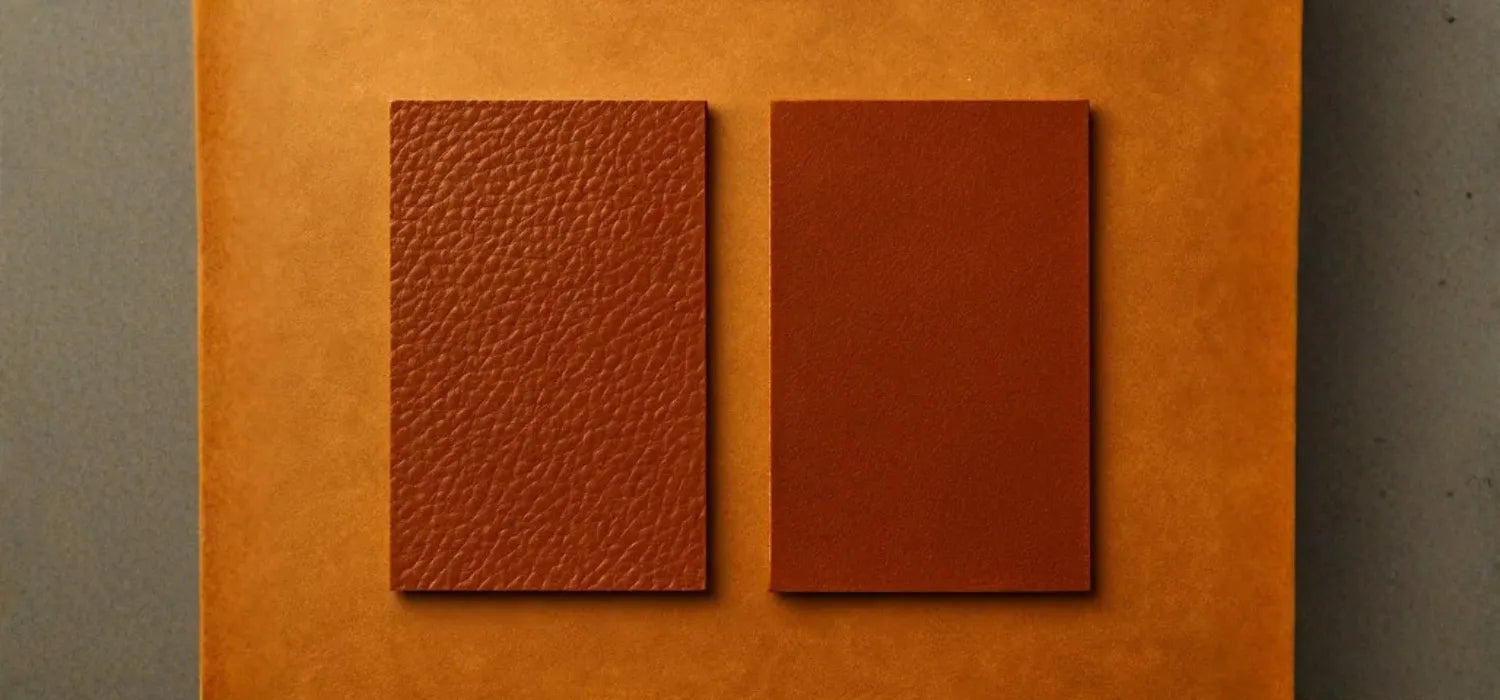
Full-grain leather retains the natural grain surface of the hide, including its pores, texture, and small variations. Leather sold as top-grain is also made from the grain-side portion of the hide, but the term is often used commercially for leather that has been lightly corrected, sanded, or finished to create a more uniform surface.
Recommendation: Choose full-grain if you value natural surface character, visible aging, and a material that can develop a distinctive patina. Choose a corrected or more heavily finished top-grain leather if you prefer a consistent appearance and greater resistance to everyday staining and surface marks. For either option, durability also depends on the thickness, tanning method, finish, construction, and intended use of the product.
What Is Full-Grain Leather?
Full-grain leather is grain-side leather whose natural grain surface has not been removed by corrective sanding or buffing. Depending on the finish, pores, wrinkles, scars, and other natural variations may remain visible. Preserving the grain layer is one reason full-grain leather is valued for durable goods, although the performance of the finished product also depends on thickness, tannage, finish, construction, and use.
What Is Top-Grain Leather?
Top-grain refers to leather made from the grain-side, or upper, portion of the hide rather than the lower split. In consumer product descriptions, the term is often used for grain leather that has been lightly sanded, buffed, corrected, or finished to make the surface more uniform. Because manufacturers and retailers do not always use the term in exactly the same way, it is worth checking whether a product is specifically described as full-grain, corrected-grain, aniline, semi-aniline, or pigmented leather.
Grain Type and Finish Are Not the Same Thing
Terms such as full-grain and corrected-grain describe what has happened to the natural grain surface of the hide. Terms such as aniline, semi-aniline, and pigmented describe how the leather surface is finished. Vegetable-tanned and chrome-tanned describe the tanning process. These characteristics overlap, but they are not interchangeable quality grades.
For example, full-grain leather may have a very light aniline finish, a semi-aniline protective finish, or another surface treatment. Likewise, the performance of corrected-grain leather depends heavily on the finish applied to it. When comparing leather products, look at the grain, finish, tannage, thickness, and intended use rather than relying on a single label.
| Attribute | Full-Grain | Top-Grain |
|---|---|---|
| Origin / Grain | Grain-side leather with the natural grain surface intact | Grain-side leather; the term may include full-grain or surface-corrected leather depending on how the manufacturer uses it |
| Surface Processing | No corrective mechanical removal of the natural grain | May be lightly buffed, corrected, embossed, or finished for greater uniformity |
| Thickness | Varies by hide, splitting, and intended product | Also varies by manufacturing specification and intended use |
| Durability | Often highly durable when appropriate thickness, tannage, and construction are used | Can also be highly durable; performance depends on correction level, finish, thickness, and application |
| Appearance | Natural pores, scars, grain variation | Smooth, even surface; fewer visible marks |
| Patina Potential | Often pronounced on lightly finished full-grain leather; varies with tannage, finish, color, and use | Varies widely; heavier protective finishes generally reduce visible patina development |
| Maintenance | Depends mainly on finish, product type, and use; lightly finished versions require more care around moisture and stains | Also finish-dependent; heavily protected or pigmented versions are generally easier to clean |
| Breathability | Depends strongly on the surface finish; lightly finished leather generally allows more moisture-vapor transfer | Heavier pigmented or polymer finishes generally reduce breathability |
| Scratch / Stain Resistance | Depends strongly on the finish; lightly finished surfaces show marks and stains more readily | Corrected leather with a protective finish may offer greater resistance to everyday staining and abrasion |
For a broader overview of leather categories, see our guide on types of leather: full-grain, top-grain, corrected-grain, split, genuine, and bonded.
Production: How the Two Types Differ
The most useful distinction is how much of the natural grain surface remains and what finishing has been applied afterward. Full-grain leather retains the original grain without corrective sanding that removes the surface. Corrected-grain leather has part of that surface mechanically altered to reduce visible defects or create a more uniform appearance. Additional finishes can then change color consistency, stain resistance, feel, and appearance.
Full-Grain: Preserving the Natural Surface
Because the natural grain remains visible, manufacturers producing clean-looking full-grain leather often prefer hides with fewer severe surface defects. However, hide selection and the full-grain designation are separate issues: full-grain primarily describes the preservation of the natural grain surface, not an automatic guarantee that the hide or finished product is the highest possible quality.
Process steps:
- The hide is prepared and tanned using a process appropriate for the intended leather, such as vegetable or chrome tanning.
- The natural grain surface is retained rather than mechanically corrected by sanding or buffing that removes the grain.
- The leather may receive an aniline, semi-aniline, wax, oil, or other finish depending on the desired appearance and performance.
- Additional surface treatments may be used as long as the natural grain has not been removed through corrective processing.
Result: The natural grain remains intact, preserving the surface characteristics of the hide. Depending on the tannage and finish, the leather may retain visible natural variation and develop increasingly noticeable surface character or patina with use.
Corrected Top-Grain: Creating a More Uniform Surface
When top-grain leather is corrected for a more uniform appearance, the grain surface is lightly sanded or buffed before finishing. The degree of correction can vary substantially between leathers.
Typical process steps may include:
- Light sanding or buffing to reduce visible scars, scratches, or irregular grain.
- Embossing to create a consistent grain pattern when required.
- Application of semi-aniline, pigmented, or other protective finishes depending on the intended product.
Result: Corrected and finished grain leather can provide a smoother, more predictable appearance and greater surface protection. Its final durability, flexibility, stain resistance, and feel depend on the amount of correction, the finish, the leather thickness, and the intended application.
Comparing Key Characteristics
The practical differences between leather types become clearer when grain structure, surface correction, and finish are considered together. Full-grain is valued for preserving the natural surface, while corrected and more heavily finished grain leathers can offer greater visual consistency and surface protection.
Durability and Wear Resistance
Retaining the natural grain surface can be an advantage in products designed for long-term wear, which is one reason full-grain leather is widely used for belts, boots, bags, and other durable goods. Many lightly finished full-grain leathers also develop visible surface character rather than simply looking worn as they age.
However, the words “full-grain” alone do not guarantee a longer-lasting product. Leather thickness, tannage, finish, fiber quality, product construction, stitching, edge treatment, and the conditions of use can be just as important. A well-made corrected-grain product designed for heavy use can outperform a poorly constructed full-grain product.
Appearance and Patina
Full-grain leather retains the original grain surface, so natural variations such as pores, wrinkles, and small marks may remain visible, particularly under light or transparent finishes. Many lightly finished full-grain leathers develop noticeable color and surface changes with handling, sunlight, oils, and wear, although the appearance of that patina varies by tannage, finish, color, and use.
Corrected or heavily finished grain leather generally offers a more uniform appearance. Protective or pigmented finishes can reduce visible changes from handling and exposure, which may be an advantage for buyers who prefer the product to maintain a consistent look over time.
Care Requirements
Care requirements depend more on the finish and the type of product than on the full-grain or top-grain label alone. Lightly finished aniline leather is generally more sensitive to water, oils, and staining, while semi-aniline and pigmented finishes provide progressively more surface protection.
Avoid conditioning leather according to a universal calendar. A wallet used daily, a pair of boots exposed to rain, and an upholstered chair all require different care. Follow the manufacturer's instructions, clean spills promptly, and condition the leather when recommended or when it begins to feel noticeably dry. Over-conditioning can also change the feel, color, or surface appearance of some leathers.
Breathability and Tactile Feel
Breathability and tactile feel depend heavily on how the leather is finished. Lightly finished aniline and semi-aniline leathers generally retain a more natural surface feel and allow greater moisture-vapor transfer than leather covered with a heavier pigmented or polymer finish.
Do not assume that every full-grain leather will feel softer or more breathable than every corrected-grain leather. Thickness, tannage, oils, waxes, coatings, and the intended use of the material can produce very different results even within the same grain category.
Scratch and Stain Resistance
Stain and scratch resistance depend primarily on the finish. A pigmented or otherwise protected surface generally handles spills and everyday abrasion better than lightly finished aniline leather, whether the underlying leather is full-grain or corrected-grain.
On lightly finished leather, scratches and scuffs may remain visible or gradually become part of the surface character as the product ages. Do not automatically buff or condition a scratch: the correct treatment depends on the finish, and an unsuitable product or aggressive rubbing can change the color, sheen, or texture. Follow the maker's care instructions and test treatments on an inconspicuous area first.
When to Choose Each Type
When Full-Grain Leather Makes Sense
Full-grain leather is a strong choice when you want the natural grain to remain visible and you appreciate the way lightly finished leather can change with handling, sunlight, oils, and everyday wear. It is particularly attractive for products where surface character is part of the design rather than something the manufacturer is trying to keep perfectly uniform.
Ideal uses:
- Belts, wallets, and everyday carry goods where visible aging and patina are desirable
- Briefcases, messenger bags, and luggage designed to develop character with use
- Minimalist wallets, passport holders, and watch straps where natural grain variation is part of the appeal
- Boots and other durable goods when the leather thickness, tannage, finish, and product construction are also appropriate for the application
When Corrected or Protected Grain Leather Makes Sense
Corrected or more heavily finished grain leather can be a practical choice when consistent color, predictable texture, and resistance to everyday staining are more important than visible natural grain variation or pronounced patina. These characteristics come primarily from the correction and finishing process rather than from the “top-grain” label by itself.
Ideal uses:
- Fashion bags and everyday wallets with a clean, polished look
- Furniture and automotive upholstery where consistent appearance and a protective finish are important; for these applications, check the manufacturer's abrasion, colorfastness, finish, and maintenance specifications rather than choosing by grain label alone
- Lightweight jackets, gloves, and accessories that benefit from flexibility and softer feel
Important: “Full-grain” is a useful material description, but it is not a complete quality certificate for the finished product. A high-quality leather item also depends on appropriate thickness, tannage, finish, cutting, stitching, edge construction, hardware, and how well the material is matched to its intended use.
| Priority | Recommendation | Reason |
|---|---|---|
| Long-term natural wear is a priority | Often full-grain | Preserved grain and lighter finishes can age attractively, but overall lifespan also depends on construction and application |
| Prefer a uniform surface | Corrected or protected grain leather | Surface correction, embossing, or finishing can create greater visual consistency |
| Easy cleaning is a priority | Protected or pigmented leather | A protective surface finish generally provides better resistance to everyday spills and soiling |
| Patina development important | Full-grain | Natural aging creates rich character |
| Furniture or automotive upholstery | Application-specific upholstery leather | Prioritize finish, abrasion resistance, colorfastness, maintenance requirements, and manufacturer specifications |
How to Evaluate Full-Grain and Top-Grain Leather Claims
You usually cannot identify full-grain leather with certainty from appearance or touch alone. Surface finishes, embossing, color, and manufacturing techniques can make different types of leather look surprisingly similar. Visual and tactile clues are useful, but the seller's material specification is more reliable than any single at-home test.
How to Identify Full-Grain Leather
Useful clues:
- The seller explicitly identifies the material as full-grain rather than using only broad terms such as “real leather” or “genuine leather.”
- Natural grain variation, pores, wrinkles, or small surface marks may remain visible, especially on lightly finished leather.
- The grain pattern may vary naturally across the product rather than repeating with perfect uniformity.
- Premium manufacturers may disclose additional information such as the tannery, tannage, finish, leather thickness, or hide origin.
Do not rely on appearance alone: Embossing and modern finishing can reproduce a convincing grain pattern, while some genuine full-grain leathers may have finishes that make the natural surface less obvious.
Do not use a water-drop test to identify full-grain leather. Water absorption is strongly affected by the surface finish and protective treatments, so it does not reliably identify the grain type. Water can also leave a visible mark on sensitive leather.
How to Identify Top-Grain Leather
Possible clues:
- A highly uniform grain pattern may indicate surface correction or embossing.
- Pores and natural variations may be less visible under a pigmented or protective finish.
- The surface may feel more consistent and protected than lightly finished aniline leather.
- Product specifications may use terms such as corrected-grain, embossed grain, semi-aniline, or pigmented leather.
None of these clues proves the leather type by itself. Thickness and softness are especially unreliable indicators because both can be adjusted during manufacturing for different products.
What Actually Determines Leather Quality?
Grain classification is only one part of leather quality. A full-grain label tells you something important about the surface of the leather, but it does not tell you whether the finished wallet, belt, bag, boot, or piece of furniture is well made.
When comparing products, also consider the leather thickness, tanning method, surface finish, consistency of the hide, stitching, edge finishing, lining, hardware, and whether the material was selected for the intended application. For example, a well-engineered pigmented upholstery leather may be a better choice for a heavily used car seat than a delicate aniline full-grain leather, while a lightly finished full-grain leather may be much more appealing for a wallet designed to develop patina.
Bottom line: Treat “full-grain” as a material characteristic, not as a complete quality certificate. The best leather is the leather whose grain, finish, thickness, tannage, and construction suit the product you are buying.
FAQ
What is corrected-grain leather, and is it the same as top-grain?
Corrected-grain leather has had part of the natural grain surface mechanically removed or modified, typically through sanding or buffing, to reduce visible defects or prepare the surface for a more uniform finish. It may then be embossed or pigmented. In consumer retail, corrected-grain leather is often marketed within the broader “top-grain” category, although terminology can vary between manufacturers and technical classification systems.
How does the type of finish (aniline, semi-aniline, pigmented) affect the choice between full-grain and top-grain?
- Aniline leather has the natural grain clearly visible and no opaque pigmented surface coating. It offers a natural appearance and feel but relatively little protection from staining and soiling. Depending on the leather and its use, visible patina can develop over time.
- Semi-aniline leather has a finish containing a small amount of pigment while the natural grain remains clearly visible. It generally provides more surface protection than aniline leather while retaining much of the natural appearance.
- Pigmented leather has the natural grain or surface concealed by a finish containing pigments. This provides high color consistency and generally greater surface protection against soiling and everyday wear, while reducing the visible natural character and patina of the leather.
Can top-grain leather develop patina like full-grain?
Yes, but the amount of visible patina depends more on the finish, tannage, color, and use than on the “top-grain” label alone. Lightly finished leather generally shows more change from handling, oils, sunlight, and wear, while heavier pigmented or protective finishes tend to keep the appearance more consistent.
Is full-grain leather waterproof?
Full-grain leather is not automatically waterproof. Its resistance to water depends heavily on the tannage, oils, waxes, surface finish, and any protective treatment applied by the manufacturer. Some full-grain leathers tolerate moisture well, while lightly finished aniline leather may darken or stain quickly. Use only water-resistant treatments that are compatible with the specific leather and finish, because they can change color, sheen, feel, or future patina development.
Is nubuck considered top-grain?
Nubuck is made by lightly buffing the grain side of leather to create a fine, velvety nap. Because the original grain surface has been mechanically altered, nubuck should not be confused with an untouched full-grain surface. Classification terminology varies, however, so retailers may group nubuck differently within broader grain-leather categories.
Can full-grain leather be pigmented?
Yes. “Full-grain” describes the condition of the grain surface, while “pigmented” describes the finish, so the terms are not mutually exclusive. A pigmented coating can partially or completely obscure the natural appearance that many buyers associate with full-grain leather, which is why lightly finished full-grain leather is more commonly emphasized in premium consumer goods. The important point is that applying a finish is not the same as mechanically removing the natural grain surface.